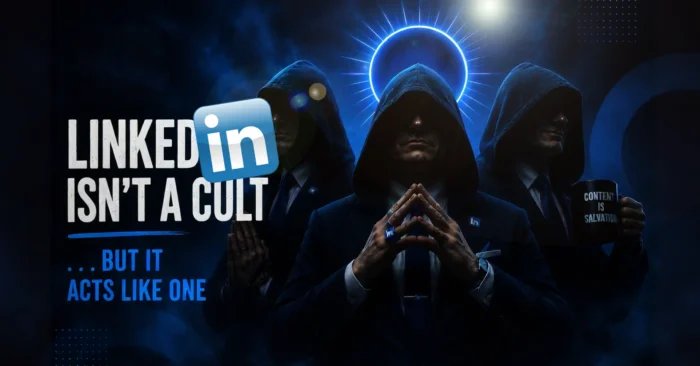
LinkedIn Isn’t a Cult—But It Acts Like One
LinkedIn is not a cult, but it sure brings out the cultish aspect of people. Without resorting to being sensationalist, let me explain, and this may take a while. So let’s “lock in”.
Full disclosure. I follow Moon on YouTube and this was a video essay that he had published recently and it resonated with me. I wanted to add my two cents to the discourse and share and agree with their findings.
Most observers classify LinkedIn as a “social network for professionals.” Initially, it was designed as a repository and way to share your resume online. It was a job marketplace for everyone. However, it has become something more and somewhat weird. To understand what is actually happening within the walls of LinkedIn requires looking past a functional utility and into the architecture of social interaction itself. Critics dismiss the phenomenon as merely “Linkedin is weird.” This misses the point. The platform has become an awkward space because it demands a specific, ritualised behaviour from every user who uses it. Labeling LinkedIn as a literal cult would be problematic. It is undeniable that the site exhibits the precise social dynamics associated with high-control groups. It encourages conformity. Inside, LinkedIn ritualises language, performative belief, and public displays of loyalty in ways that mirror the mechanics of a cult or an ideological community.
When I use ‘cult’ in this context, it’s not meant to be malicious. The issue is systemic. Initially, the platform wasn’t designed to brainwash users, but the algorithm created a system where cult-like behaviour emerged. It transforms ordinary people into permanent performers. Success isn’t just about doing good work or showing it; it’s about advancing and moving up in your organisation or profession. It’s no longer about ‘professional networking’; it shapes the human psyche like ideological communities. The platform’s design incentivises behaviours that reinforce identities through visibility, creating an environment where success is measured by work broadcasted, not produced. Many LinkedIn social dynamics resemble those in high-control groups because it taps into our human need to belong. LinkedIn doesn’t create these behaviours; it amplifies them. The drive to conform is inherent in business people. The desire for public loyalty and the need to perform identity are part of working in an organisation. Joining the network means adopting its rituals.
On LinkedIn, if you cannot articulate your job using specific terms, you are invisible to the collective eye.
I can say this because I have been outside of any organisation for almost nine years and it has led me to think that the need to belong is a strong social force. LinkedIn, like any other social network, provides this means, especially if you are not in a group dynamic. So you go on Linkedin and you have a happy community of like-minded people all the while knowing that Linkedin itself is pushing its own agenda. In order for you to stay on the network, it keeps you hooked by showing what other people have been doing so that you could match and or surpass the other people in your group dynamic.
The Liturgy of Jargon
Every religious or ideological movement requires a vernacular to distinguish the initiated from the outsiders. On LinkedIn, this language has evolved from business shorthand into a liturgy of identity markers. Phrases like “thought leadership,” “leveraging synergies,” and “driving impact” functioned as corporate euphemisms for basic functions once. Today, they serve as catchphrases that separate members from non-members. This linguistic evolution is generational; every cohort invents new workplace terminology. However, LinkedIn amplifies this into an identity marker. Writing a post using “growth mindset” isn’t just about describing a psychological concept; it’s a public declaration of your values alignment with the platform’s dominant ideology. Similarly, using the phrase “circle back” signals that you operate within the network’s specific time and social contract. These terms do not necessarily add information; they serve as passwords to access the community.
This linguistic gatekeeping fosters an exclusive in-group, similar to how high-control groups define membership based on one’s proficiency in speaking the correct dialect. On LinkedIn, if you cannot articulate your job using specific terms, you fade from view. This mirrors how sects use language to reinforce separation; here, it reinforces professional separation. The result is that work becomes a ritual of speech rather than an act of creation. You are not defined by what you build, but by how you speak about your building process. This transforms language from a tool for communication into a test of membership, requiring constant performance of the right jargon to maintain professional relevance.
You are constantly curating your reality for an audience that may never see it.
The Dual Identity: Employee and Marketer
On LinkedIn, content is king. There is only performance. One of the platform’s strongest structural features erases the line between work and publicity. No private professional life exists here. You are not simply working; you are constantly announcing your labor for consumption. Every user must function simultaneously as an employee and a marketer. Everything revolves around personal branding. Updates like promotions, anniversaries, lessons from failures, and gratitude for small things like coffee breaks are not simple updates. They are content.
We have come to a point in our professional lives where not being on LinkedIn, but still having a job, makes us invisible. This constant visibility requires a level of self-scrutiny that rivals the demands of religious professionals. If you have done nothing notable today and have not posted on LinkedIn, social pressure forces you to manufacture a narrative. This is psychological warfare at the highest level. It creates a state of perpetual availability where rest feels strange and privacy is interpreted as indifference. In traditional work cultures, a quiet week signaled deep focus. On LinkedIn, it is a failure of communication strategy. This forces professionals to police their own emotions and actions through the lens of the camera, even when the camera is metaphorical. You are constantly curating your reality for an audience that may never see it.
You have to self-censor. Because you don’t know who is watching, you don’t know who is reading, and you don’t know what others’ opinions are when you post on social media. This is the dangerous fact of being on social media as a whole. You must self-censor unless you risk becoming an outcast for speaking truth.

Vulnerability Has Become Currency
In developing your personal brand, trauma provides feedback. No one wants to hear about your successes; they only want to hear about your failures. Bad news is shared more often than good news and carries more emotional resonance. The most startling shift in recent years is the commodification of vulnerability. In many high-control groups, the sharing of personal trauma is encouraged to solidify bonds and demonstrate commitment to the group’s cause. On LinkedIn, we translate this into social currency. We normalize posts detailing layoffs, funerals, illnesses, and mental health struggles, not because people are suddenly more honest, but because the platform rewards emotional disclosure with visibility.
When an employee posts about being let go, they aren’t just sharing a personal tragedy; they frame it as a stepping stone toward “new opportunities.” This is what psychologists call performative authenticity. It creates the illusion of transparency while serving the function of a brand story. The human experience becomes raw material to be mined for engagement, stripped of its context but polished for maximum impact. In this system, grief is just content with a sad caption. By turning tragedy into a narrative of resilience, you neutralize the emotional weight of failure and repackaging it as a badge of honor that others can consume without understanding the gravity of the event. This creates a culture where suffering is monetized and normalized, stripping away the communal support usually reserved for genuine crises.
You are constantly searching for the affirmation—that reaction, that share, that engagement—all of these things represent the dopamine hit that LinkedIn gives you on the business side of things. You do it on Facebook and feel that your friends are supportive, yet they are simply observing your mental degradation. On LinkedIn, your professional reputation faces scrutiny and commoditization.
In this system, grief is just content with a sad caption.
The Pressure to Believe
One store manager taught me that failure is part of life. It’s important to learn from your failure. That was a very important lesson for me because I was always afraid of failure. But on LinkedIn, presenting failure means reframing it into a different narrative. Optimism is mandatory. You rarely see posts saying “Today was boring.” Instead, you get “Five lessons my redundancy taught me.” Failure is not allowed to remain failure; it must be converted into resilience. Every Tuesday must yield a lesson. Every setback must be framed as a setup for a comeback.
LinkedIn fosters an echo chamber culture where reality takes a backseat to narrative. If your workday is uneventful, you must invent an insight. The platform rewards this behavior, encouraging groups to demand meaning and suffering for stability. LinkedIn automates this process, rewarding posts about struggles with likes from validating users. Inactivity renders you invisible to the community’s attention economy, effectively teaching professionals that their worth is tied to spinning any situation into a victory story. This pressure forces authenticity to appear as progress.

Corporate Evangelism
This brings us to the role of corporate evangelism on the platform. Employees are no longer just workers; they become ambassadors for their companies’ cultures. They write about how much they love their boss, even if their manager has been harsh. Founders preach hustle culture as a virtue; recruiters sell careers that do not exist yet; coaches sell transformations that require their specific coaching services. Everyone on the platform sells belief in something.
In traditional religions, tithes fund the church to support the preacher. On LinkedIn, preaching happens without pay. The employee must perform a level of enthusiasm and loyalty that rivals a missionary, all while working toward their own economic goals. They become mouthpieces for the organizations they work for, blurring the line between self-identity and corporate brand identity. This pressure compels professionals to feel responsible for maintaining the company’s reputation in perpetuity, even after leaving. The result is an internalization of corporate values that can linger long after employment ends, affecting how individuals interact with their own sense of worth and achievement.
The Exit Trap
One of the most cult-like characteristics of high-control groups is how difficult it is to leave once you are in. On LinkedIn, this difficulty has been repurposed into a professional asset. People announce that they are leaving their jobs only to stay on the platform as ghosts in their former company’s network. Deleting your profile poses a risk because employers expect your presence there.
Leaving feels like losing a limb. Your history, connections, and value get digitized within this single ecosystem. This creates a form of soft lock-in. The more time you spend on the platform, the more difficult it is to conceptualize an identity outside of it. To leave isn’t just deleting an app; it’s stepping out of the collective consciousness of your industry. You aren’t just quitting a job; you are risking social isolation within the sector. This lock-in mechanism forces individuals to remain compliant with the platform’s norms even when they personally disagree, because leaving feels like professional suicide.
Failure is not allowed to remain failure; it must be converted into resilience.
Algorithms Reward Conformity
As mentioned before, algorithms reward conformity. Social media platforms aim to maximize time on site, but on LinkedIn, they do so by maximizing engagement with familiar content. Users realize that their posts perform better when they follow a certain template: the hook, the emojis, the moral lesson, the call to actions. We’ve all seen it. These are all the things that users adopt unconsciously.
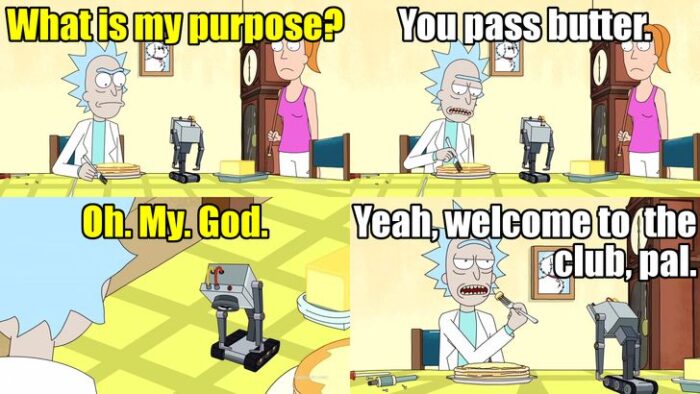
It’s almost as if an AI has taken over. The result is uniformity emerging naturally from the math of engagement. Eventually, everyone writes in the same format with the same lessons, stories, and hooks. To quote Linkin Park’s “When They Come For Me”: a blueprint is a gift and a curse. Once you get a theory of how the thing works, everybody wants the next thing to be just like the first. This is how LinkedIn works. What should be shared essentially becomes what “works”. If you post something truly unique that doesn’t fit the mold, the system hides it. This creates a self-censorship culture where professionals pre-edit their thoughts to align with the algorithm’s expectation of what constitutes “professional content,” effectively narrowing the scope of public discourse on work.
AI Is Making It Worse
We must also consider the role of artificial intelligence in this ecosystem. AI writes profiles, cover letters, comments, and interview questions now. Soon, AI will talk to AI while humans simply supervise. This represents a shift where the “performative authenticity” required on LinkedIn shifts from human-generated to generated.
If you post from a feed curated by an algorithm that suggests content based on your past interactions with corporate values, you risk becoming part of a system where humans supervising AI generate the same performative outputs we critique. Removing the friction of writing a comment scales the production of “thought leadership” and makes it cheap. This removes the need for genuine human experience; instead, it requires only enough input to satisfy the machine. We move toward a future where professional networking performs by bots, further cementing the illusion of activity without the substance of connection. The presence of AI amplifies the performative requirement because the barrier to entry lowers, making authenticity even more difficult to distinguish from simulation.
We are valuing the signal over the substance.
Understanding the Mechanism: High-Control Groups
Why does this feel like a cult? It isn’t because LinkedIn asks people to believe impossible things. It is because it encourages ordinary people to become permanent performers. We can understand this without hyperbole by looking at what psychologists and sociologists call “high-control groups.” These are not necessarily sinister organizations; they are simply systems that use effective social technologies to reinforce identity, loyalty, and participation.
The mechanisms are identical:
- Identity Reinforcement: Your worth is measured by your profile’s engagement.
- Insider Language: Using jargon creates a wall between you and outsiders.
- Social Proof: You need visible validation (likes) to feel valid.
- Public Commitment: Publicly stating your goals makes it harder to back out.
- Conformity: The system pushes you toward the safest, most familiar content.
- Reputation Management: Past posts are permanently archived as proof of character.
- Fear of Exclusion: Being unseen feels like professional ostracization.
- Why does this feel like a cult? It isn’t because LinkedIn asks people to believe impossible things. It is because it encourages ordinary people to become permanent performers. We can understand this without hyperbole by looking at what psychologists and sociologists call “high-control groups.” These are not necessarily sinister organizations; they are simply systems that use effective social technologies to reinforce identity, loyalty, and participation.
- The mechanisms are identical:
- Identity Reinforcement: Your profile’s engagement defines your worth.
- Insider Language: Using jargon creates a wall between you and outsiders.
- Social Proof: You need visible validation (likes) to feel valid.
- Public Commitment: Publicly stating your goals makes it harder to back out.
- Conformity: The system pushes you toward the safest, most familiar content.
- Reputation Management: Past posts serve as permanent archives of character.
- Fear of Exclusion: Not being seen feels like professional ostracization.
LinkedIn isn’t literally a cult. It shares some of the mechanisms because they work: they drive engagement and data retention. It activates these dynamics because they provide dopamine hits in an otherwise dull life. The system relies on human psychology that mirrors the mechanics of high-control groups because it is profitable to do so.
Conclusion
To use the term “cult” in relation to LinkedIn is a little dramatic, but if you look past the drama and examine the design, you find that the system relies on human psychology that mirrors the mechanics of high-control groups. LinkedIn and social media in general ask us to validate our worth through external metrics of engagement. We must adapt our reality into narratives tailored for an audience. This is ironic, no? Because success on this platform requires less expertise and more visibility, trading the substance of the expert for the performance of the influencer.
LinkedIn acts as a mirror that amplifies our deepest professional needs to the point where we mistake reflection for reality. Therefore, it’s not a cult. The danger lies in the fact that influencers shape our reality, yet it should be the other way around. It encourages ordinary people to become permanent performers, as the world’s largest profession increasingly demands professionals behave like influencers. This blurs the line between work and personal life. If we believe that the medium is the message, then LinkedIn becomes the message that teaches us to be the business life and successful person we desire. We are valuing the signal over the substance.
LinkedIn started as a networking platform, but it has become about building your brand, rather than building your career. The platform’s structure creates pressure, exploiting our human desire to be seen, heard, and belong. This pressure erodes the line between authentic expression and performative necessity. The platform doesn’t create believers; it simply amplifies them. It brings out the cultish aspects latent in business people because it rewards them for conforming. The system relies on human psychology that mirrors the mechanics of high-control groups because it is profitable to do so.
Are you feeling the same? Drop a comment and let me know your thoughts.Drop a comment and let me know your thoughts. Did you find this blog useful? I’m looking to write more for my blog, so I’d love to hear your feedback. If you enjoyed reading this, please leave a comment below. If you’re interested in hiring me for your digital executions, get in touch here. Thanks for reading.